
What is Genomics?
Genomics is a field of biology focused on studying all the DNA of an organism — that is, its genome. Such work includes identifying and characterizing all the genes and functional elements in an organism’s genome as well as how they interact. Genomics and Genetics
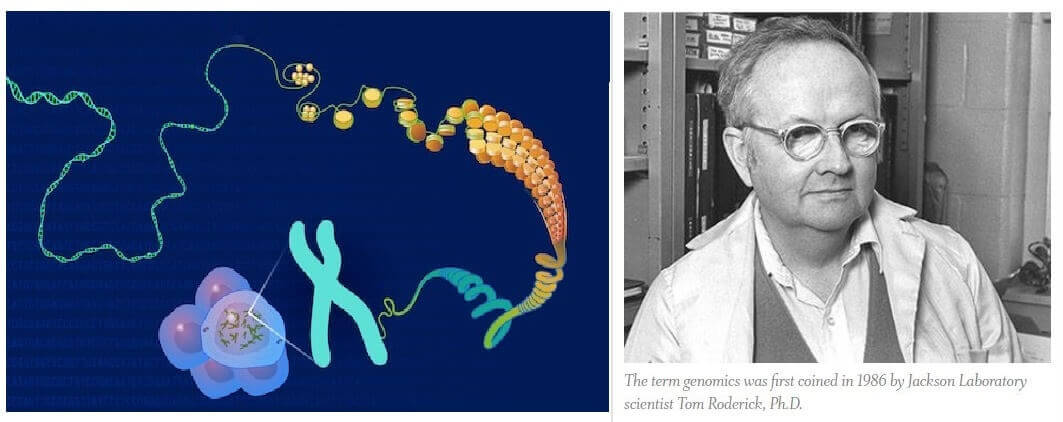
A genome is all the DNA of an organism. In 1987, a new field of science was named called genomics. Genomics focuses on the study of genomes, doing so with a style that is often focused on examining all of the DNA of an organism as opposed to just bits and pieces. In the decades that have followed the original coining of the word genomics, the field has seen substantial growth from a very basic science endeavor to now being a major part of a wide range of activities, ranging from medicine to agriculture to environmental monitoring to ancestry to forensics.
Genomics applications
Functional genomics
Analysis of genes at the functional level is one of the main uses of genomics, an area known generally as functional genomics. Determining the function of individual genes can be done in several ways. Classical, or forward, genetic methodology starts with a randomly obtained mutant of interesting phenotype and uses this to find the normal gene sequence and its function. Reverse genetics starts with the normal gene sequence (as obtained by genomics), induces a targeted mutation into the gene, then, by observing how the mutation changes phenotype, deduces the normal function of the gene. The two approaches, forward and reverse, are complementary. Often a gene identified by forward genetics has been mapped to one specific chromosomal region, and the full genomic sequence reveals a gene in this position with an already annotated function.
Comparative genomics
A further application of genomics is in the study of evolutionary relationships. Using classical genetics, evolutionary relationships can be studied by comparing the chromosome size, number, and banding patterns between populations, species, and genera. However, if full genomic sequences are available, comparative genomics brings to bear a resolving power that is much greater than that of classical genetics methods and allows much more subtle differences to be detected. This is because comparative genomics allows the DNAs of organisms to be compared directly and on a small scale. Overall, comparative genomics has shown high levels of similarity between closely related animals, such as humans and chimpanzees, and, more surprisingly, similarity between seemingly distantly related animals, such as humans and insects. Comparative genomics applied to distinct populations of humans has shown that the human species is a genetic continuum, and the differences between populations are restricted to a very small subset of genes that affect superficial appearance such as skin color. Furthermore, because DNA sequence can be measured mathematically, genomic analysis can be quantified in a very precise way to measure specific degrees of relatedness. Genomics has detected small-scale changes, such as the existence of surprisingly high levels of gene duplication and mobile elements within genomes.
(Difference between Genomics and Genetics)
The terms sound alike, and they are often used interchangeably. But there are some important distinctions between genetics and genomics.
Genetics is the study of heredity, or how the characteristics of living organisms are transmitted from one generation to the next via DNA, the substance that comprises genes, the basic unit of heredity. Genetics dates back to Augustinian friar and scientist Gregor Mendel, whose studies of pea plants in the mid-1800s established many of the rules of heredity.
Genetics involves the study of specific and limited numbers of genes, or parts of genes, that have a known function. In biomedical research, scientists try to understand how genes guide the body’s development, cause disease or affect response to drugs.
Genomics, in contrast, is the study of the entirety of an organism’s genes – called the genome. Using high-performance computing and math techniques known as bioinformatics, genomics researchers analyze enormous amounts of DNA-sequence data to find variations that affect health, disease or drug response. In humans that means searching through about 3 billion units of DNA across 23,000 genes.
Genomics is a much newer field than genetics and became possible only in the last couple of decades due to technical advances in DNA sequencing and computational biology.
JAX has expertise in both genetics and genomics. Scientists at our Bar Harbor, Maine, headquarters practice basic, experimental genetics using mice while scientists at The Jackson Laboratory for Genomic Medicine, our research center in Farmington, Conn., study the human genome.
These scientists collaborate with one another, and their complementary approaches are essential to discovering precise genomic solutions for human disease.
*Source: National Human Genome Research Institute, Britannica
